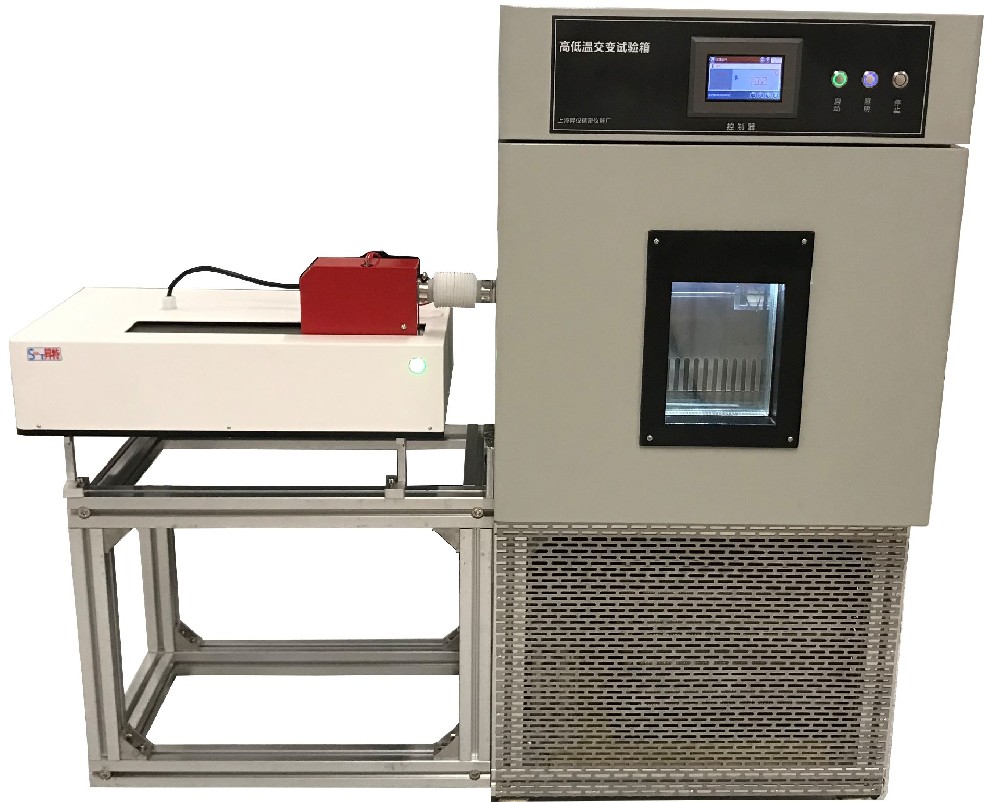

The temperature and humidity of the laboratory air affect the moisture content and regain of the fiber, as well as the macromolecular structure within the fiber, thereby influencing the tensile properties of the single fiber.
1. Temperature
The tensile strength of fibers is mainly affected by the internal macromolecular structure and local defects. At high temperatures, the internal macromolecular structure is the dominant factor. In textile chemistry, for fiber polymers, high temperature generally refers to the temperature range from minus 100 degrees Celsius to above room temperature, while low temperature refers to temperatures below minus 200 degrees Celsius. The experimental ambient temperature specified in GB/T14337-2008 "Test method for tensile properties of short fibers of chemical fibers" falls within the high temperature range.
When the moisture regain of the fiber is constant, an increase in temperature intensifies the thermal motion of the internal macromolecules, increasing the flexibility of the macromolecules and weakening the intermolecular forces. Therefore, under normal circumstances, as the temperature rises, the tensile strength of the fiber decreases, the elongation at break increases, and the initial tensile modulus decreases.

2. Humidity
The moisture absorption mechanism is the intrinsic factor determining the moisture absorption properties of fibers. Changes in laboratory relative humidity primarily affect the tensile properties of fibers through their impact on the moisture regain rate.
Hydrophilic groups in fibers are the decisive factor influencing their moisture absorption. Through association with water molecules, hydrophilic groups reduce the dependence of water molecules within the fiber. Therefore, the more hydrophilic groups a fiber contains, the stronger its polarity and the higher its moisture absorption capacity. At a given temperature, a higher relative humidity leads to a greater moisture regain rate of the fiber.
Under normal circumstances, the higher the moisture regain of the fiber, the lower its strength and the greater its elongation. This is because as the moisture regain increases, the intermolecular forces weaken and the crystalline regions loosen, leading to a decrease in fiber strength and an increase in elongation. As shown in Table 2, the dry-to-wet strength ratio of viscose fiber is 50%, and its dry-to-wet elongation ratio is 120%, while the dry-to-wet elongation ratios of sheep wool are 75% and 120%, respectively. However, for polyester and polypropylene fibers, the effect is not very significant; the wet-to-dry strength ratio of both polyester and PP fibers is 100%, and their wet-to-dry elongation ratio is also 100%.
The reason is that viscose fiber is composed of cellulose macromolecules, each containing glucose residues with three hydroxyl groups. Therefore, it has strong hygroscopicity. The macromolecules in wool fibers are condensed from α-amino acids and contain many amino, amide, and carboxyl groups, resulting in good moisture absorption. However, polyester and polypropylene macromolecules lack hydrophilic groups or have weak polarity, so their moisture absorption performance is also poor. Therefore, during the tensile test, controlling the laboratory relative humidity is particularly important for the reliability of the test results, especially for hydrophilic fibers.